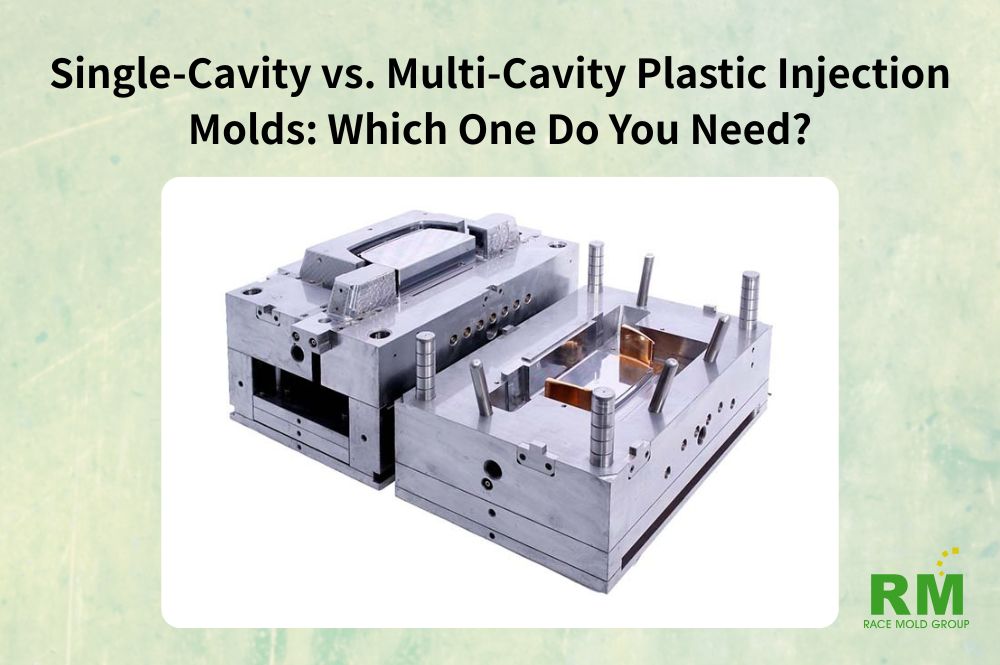
When planning a plastic injection molding project, one of the most important early decisions is whether to use a single-cavity or multi-cavity mold. The number of cavities directly impacts tooling cost, production efficiency, part consistency, and long-term profitability.
At RACE MOLD INDUSTRIAL CO., LTD., we frequently assist customers in evaluating their production goals to determine the most suitable mold structure. This article explains the differences between single-cavity and multi-cavity plastic injection molds and outlines how to choose the right option for your project.
What Is a Single-Cavity Injection Mold?
A single-cavity mold produces one part per injection cycle. It is the simplest mold configuration and is commonly used for:
- Prototype development
- Low-volume production
- Large-sized components
- Products requiring tight tolerance validation
- High-mix, low-volume manufacturing
Because only one cavity is machined, the mold structure is typically less complex, and the initial tooling cost is lower.
Advantages of Single-Cavity Molds
- Lower upfront tooling investment
- Easier mold maintenance
- Faster mold development timeline
- Simpler dimensional control
- Ideal for part validation and engineering changes
However, cycle efficiency is lower since only one part is produced per shot.
What Is a Multi-Cavity Injection Mold?
A multi-cavity mold produces multiple identical parts in one injection cycle. Depending on part size and machine capacity, molds may include 2, 4, 8, 16, or even more cavities.
Multi-cavity molds are widely used for:
- High-volume consumer goods
- Automotive components
- Medical disposables
- Electronic housings
- Standardized industrial parts
This configuration significantly increases production output without increasing cycle time.
Advantages of Multi-Cavity Molds
- Higher production efficiency
- Lower per-part manufacturing cost
- Better utilization of machine capacity
- Improved profitability for mass production
However, tooling complexity and cost increase due to cavity balancing, runner design, and cooling requirements.
Key Differences Between Single and Multi-Cavity Molds
| Factor |
Single-Cavity Mold |
Multi-Cavity Mold |
| Parts per cycle |
1 |
Multiple |
| Tooling cost |
Lower |
Higher |
| Production speed |
Lower |
Higher |
| Dimensional control |
Easier |
More complex balancing required |
| Suitable volume |
Low to medium |
Medium to high |
| Maintenance |
Simpler |
More complex |
Multi-cavity molds require precise flow balancing and cooling symmetry to ensure that all cavities fill evenly and produce consistent parts.
Cost Considerations: Upfront vs Long-Term Investment
Choosing between single and multi-cavity molds often depends on production volume. If annual volume is low, a single-cavity mold may provide better return on investment due to lower tooling cost. If production demand is high, a multi-cavity mold reduces cost per unit significantly over time. Although the initial tooling investment is higher, the long-term savings in cycle efficiency often justify the cost. A break-even analysis is usually recommended before making the decision.
Quality and Dimensional Consistency
Single-cavity molds are easier to control because only one cavity must meet tolerance requirements. Multi-cavity molds demand:
- Balanced runner systems
- Uniform cooling design
- Precise machining across all cavities
- Consistent steel hardness and surface finish
Without proper engineering, multi-cavity molds can produce dimensional variation between cavities. This is why mold flow simulation and advanced machining precision are essential when designing multi-cavity systems.
When Should You Choose Single-Cavity?
Single-cavity molds are recommended when:
- Production volume is limited
- The part is large or complex
- Engineering changes are expected
- Tight tolerance validation is required
- Budget constraints limit tooling investment
They are also ideal during early-stage product development.
When Should You Choose Multi-Cavity?
Multi-cavity molds are ideal when:
- Production demand is stable and high
- Part design is finalized
- Unit cost reduction is critical
- Production speed is a priority
- Machine tonnage allows multi-cavity layout
Automotive and appliance manufacturers commonly use multi-cavity molds to achieve cost efficiency at scale.
RACE MOLD INDUSTRIAL CO., LTD. Engineering Perspective
At RACE MOLD INDUSTRIAL CO., LTD., we support customers in selecting the right cavity configuration based on part size, material, projected annual volume, and budget strategy. Our capabilities include:
- Mold flow analysis for cavity balancing
- High-precision CNC and EDM machining
- Support for molds up to 25 tons
- Experience across automotive, industrial, appliance, medical, and electronic industries
- Compliance with international mold standards such as DME and Hasco
By combining engineering analysis with practical production planning, we help clients optimize tooling investment and long-term manufacturing efficiency.
FAQ: Single vs Multi-Cavity Injection Molds
1. Is a multi-cavity mold always more cost-effective?
Not necessarily. It depends on annual production volume. High volumes justify multi-cavity tooling; low volumes may not.
2. Can multi-cavity molds maintain tight tolerances?
Yes, but they require advanced engineering design, balanced runner systems, and precision machining to maintain consistency across all cavities.
3. Does cycle time increase with more cavities?
No. The cycle time remains similar, but more parts are produced per cycle, increasing productivity.
4. Is maintenance more difficult for multi-cavity molds?
Yes. More cavities mean more components to maintain and monitor.
5. Can a single-cavity mold later be converted into multi-cavity?
In most cases, no. Multi-cavity molds require a completely different layout and design strategy.
Conclusion
The decision between single-cavity and multi-cavity plastic injection molds depends on production goals, budget planning, and long-term manufacturing strategy. Single-cavity molds offer flexibility and lower initial investment, while multi-cavity molds maximize efficiency and reduce per-part cost for high-volume production. Choosing the right configuration requires technical evaluation, cost modeling, and engineering foresight.
If you are evaluating cavity configurations for your next injection molding project, the engineering team at RACE MOLD INDUSTRIAL CO., LTD. is ready to help. Contact us to discuss your production volume, part design, and cost targets — and we will recommend a mold solution aligned with your manufacturing objectives.