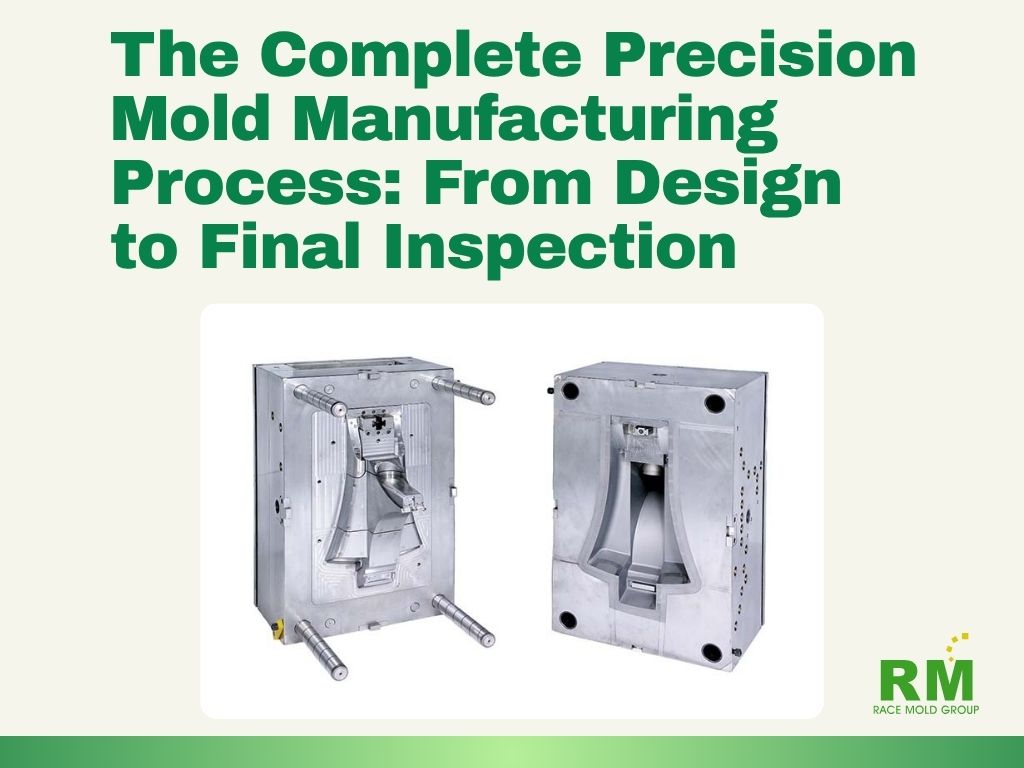
In today’s manufacturing environment, product quality, dimensional accuracy, and production efficiency all depend heavily on the precision of the molds used. Whether in automotive, electronics, medical, or industrial applications, the success of mass production starts with a well-executed precision mold manufacturing process.
RACE MOLD INDUSTRIAL CO., LTD. supports customers worldwide by delivering reliable mold solutions through a structured and production-oriented workflow. From initial product review to final mold validation, each stage plays a critical role in ensuring stable quality and long-term performance.
This article provides a complete overview of the precision mold manufacturing process — from design to final inspection — and explains how each step contributes to consistent and repeatable production results.
1. Product Design Review and Manufacturability Consideration
The process begins with reviewing the product design to ensure it is suitable for mold production. At this stage, manufacturers evaluate:
- Part geometry
- Wall thickness distribution
- Draft angles
- Undercuts and structural features
- Material characteristics
The focus is not on redesigning the product, but on identifying potential production risks and improving manufacturability where necessary.
Early-stage manufacturability review helps reduce mold modification, shorten lead time, and improve overall production stability.
2. Mold Flow Analysis and Process Planning
Before machining begins, mold flow analysis is used to simulate how material will behave inside the mold. This helps identify:
- Filling patterns
- Air entrapment areas
- Weld line locations
- Cooling behavior
- Shrinkage and deformation risks
Based on the results, engineers adjust:
- Gate position
- Runner layout
- Cooling channel arrangement
- Venting locations
This step improves first trial success and reduces the need for repeated adjustments.
3. Mold Design and Structural Layout
After confirming the process strategy, detailed mold design is developed. This includes:
- Core and cavity structure
- Insert layout
- Ejection system
- Cooling system
- Sliding and lifting mechanisms
At this stage, the focus is on ensuring that all components are properly aligned and capable of maintaining stability during long production runs.
Precision mold manufacturing requires not only dimensional accuracy but also structural durability.
4. CNC Machining and Component Manufacturing
Mold components are produced using precision machining equipment such as:
- High-speed CNC milling machines
- Five-axis machining centers
- Precision drilling and boring equipment
Critical areas are machined in multiple steps to reduce internal stress and ensure dimensional consistency.
Machining accuracy directly affects mold performance, especially for tight-tolerance parts.
5. EDM and Detail Processing
Electrical Discharge Machining (EDM) is used for features that cannot be achieved through conventional cutting, such as:
- Deep ribs
- Sharp internal corners
- Fine structural details
EDM ensures that these features are produced accurately and consistently, especially in precision mold applications.
6. Mold Assembly and Fitting
After machining, all components are assembled and carefully fitted. This includes:
- Insert alignment
- Parting surface matching
- Ejection system verification
- Mechanical movement testing
Proper fitting ensures that the mold operates smoothly and prevents issues such as flash, misalignment, or uneven wear.
7. Mold Trial and Sampling
Once the mold is assembled, trial production is conducted to evaluate performance. During this stage:
- Process parameters are adjusted
- Sample parts are inspected
- Dimensional accuracy is verified
- Surface quality is evaluated
If necessary, minor adjustments are made to achieve the required specifications.
8. Final Inspection and Quality Verification
Before delivery or mass production, the mold undergoes final inspection, including:
- Dimensional measurement
- Functional verification
- Surface quality checks
This ensures that the mold meets production requirements and can deliver consistent results over long production cycles.
RACE MOLD INDUSTRIAL CO., LTD. Manufacturing Approach
RACE MOLD INDUSTRIAL CO., LTD. follows a structured precision mold manufacturing process that emphasizes stability, repeatability, and practical production performance.
Our approach combines:
- Product review and manufacturability consideration
- Mold flow analysis for process validation
- Precision machining and controlled assembly
- Systematic inspection and verification
We support customers in automotive, appliance, electronics, and industrial sectors where consistent quality and long-term reliability are essential.
Conclusion
Precision mold manufacturing is not defined by a single process, but by the coordination of multiple stages — from initial product evaluation to final inspection. Each step contributes to the final outcome, affecting part accuracy, production efficiency, and long-term mold performance.
By following a structured and controlled manufacturing process, manufacturers can reduce risk, improve yield, and ensure consistent production results.
RACE MOLD INDUSTRIAL CO., LTD. provides precision mold manufacturing solutions focused on stable quality and reliable performance for a wide range of industrial applications.
FAQ: Precision Mold Manufacturing Process
1. What is the most important factor in precision mold manufacturing?
Consistency across all stages is critical. From design review to machining and assembly, each step must be controlled to achieve stable results.
2. How long does the mold manufacturing process take?
Depending on complexity, most molds require 4 to 10 weeks, including machining, assembly, and trial stages.
3. Why is mold flow analysis used?
It helps identify potential defects such as air traps, uneven filling, and deformation before production begins.
4. What equipment is required for precision mold manufacturing?
High-speed CNC machines, EDM equipment, and precision inspection tools such as CMM are commonly used.
5. Can precision molds support high-volume production?
Yes. Precision molds are designed to maintain dimensional stability and performance over long production runs.
Work with a Reliable Precision Mold Manufacturing Partner
If you are looking for a reliable partner in precision mold manufacturing, RACE MOLD INDUSTRIAL CO., LTD. can support your project with a structured and production-focused approach. Contact us to discuss your requirements and explore a mold solution designed for consistent quality and long-term performance.