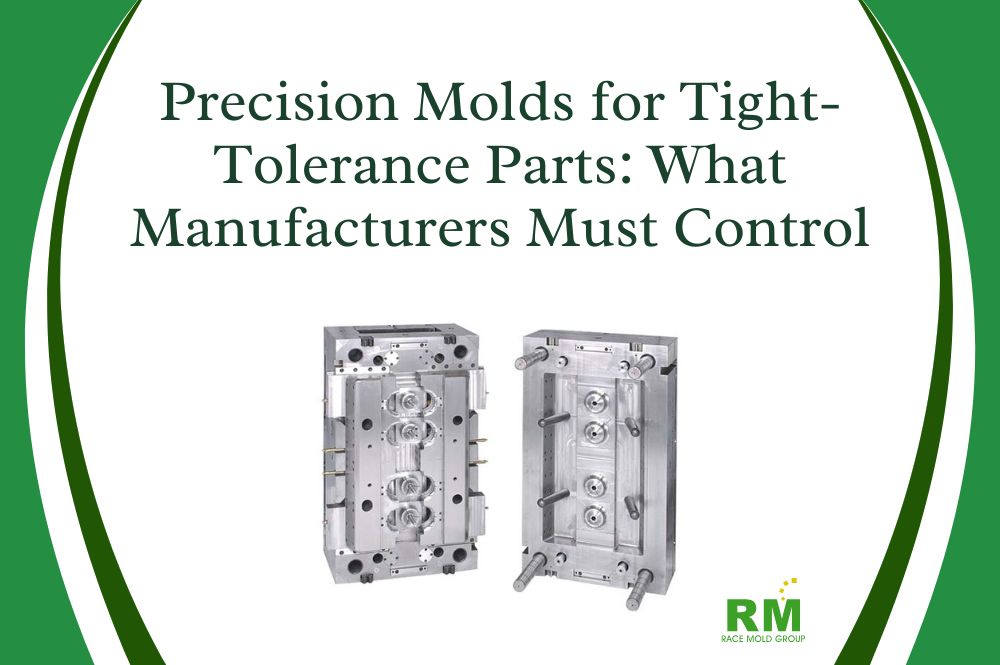
In industries where components must fit, seal, align, or move with exact precision, tight tolerances are not optional — they are fundamental requirements. From automotive connectors and medical housings to electronic modules and precision mechanical parts, dimensional accuracy directly determines performance and reliability. Achieving this level of control depends heavily on the quality of precision molds used in production.
RACE MOLD INDUSTRIAL CO., LTD. works with customers across automotive, appliance, electronics, and industrial sectors, where tight-tolerance parts demand not only advanced mold design but also strict process control throughout mold manufacturing. This article explains what manufacturers must control when developing precision molds for high-accuracy components.
Why Tight Tolerance Parts Require Precision Molds
Tight-tolerance parts typically involve:
- Press-fit assemblies
- Sealing interfaces
- Bearing or shaft alignment
- Electrical contact positioning
- Multi-component snap fits
- Optical or sensor alignment
In these applications, even a deviation of ±0.02 mm can affect function. Precision molds ensure repeatability across thousands or millions of cycles — not just first-article accuracy.
Mold Design Compensation for Material Shrinkage
Every molded material — whether plastic or die-cast metal — shrinks during cooling. Tight-tolerance mold design must account for:
- Resin shrink rate variation
- Fiber-filled material behavior
- Directional shrinkage differences
- Wall thickness effects
Precision molds are designed with shrink compensation built into cavity dimensions. Engineers rely on historical data and simulation tools to predict and offset shrinkage before steel is cut.
Without proper compensation, even a perfectly machined mold will produce out-of-spec parts.
Machining Accuracy and Equipment Capability
Precision molds require high-end machining processes, including:
- High-speed CNC milling
- Fine-step finishing passes
- Precision EDM for sharp corners
- Wire cutting for inserts and core blocks
- Five-axis machining for complex geometry
Machine resolution alone is not enough — stability, tooling strategy, and thermal control during machining also affect final accuracy.
Critical tolerance areas are often machined in multiple stages to minimize stress and distortion.
Insert and Core Alignment Control
Many tight-tolerance parts depend on multiple inserts forming a single functional feature. Misalignment between inserts can cause:
- Offset holes
- Flash lines
- Uneven wall thickness
- Functional interference
Precision molds use:
- Ground reference surfaces
- Precision dowel systems
- Matched insert pairs
- Controlled assembly sequencing
Insert alignment is verified repeatedly during mold assembly and fitting.
Thermal Stability and Mold Temperature Control
Temperature variation changes steel dimensions — even small shifts affect tight-tolerance cavities.
Manufacturers must control:
- Cooling channel balance
- Mold temperature uniformity
- Hot runner thermal behavior
- Heat concentration zones
Precision molds often use zoned cooling layouts to maintain stable cavity temperature and prevent dimensional drift during long production runs.
Surface Finishing and Micro-Geometry Control
Surface finish affects both part appearance and dimensional behavior. Polishing, texturing, and coating must be controlled because they change cavity size at the micron level.
Key finishing controls include:
- Controlled polishing sequence
- Measured material removal
- Surface roughness verification
- Edge break and radius control
For tight-tolerance components, finishing is measured — not just visual.
Mold Flow and Warpage Simulation
Simulation is a critical tool for tight-tolerance mold development. Mold flow and warpage analysis help predict:
- Filling pressure distribution
- Cooling behavior
- Deformation trends
- Weld line locations
- Residual stress zones
By adjusting gate location, runner size, and cooling layout, engineers reduce distortion risk before manufacturing begins.
This reduces mold correction cycles and improves first-trial success.
Precision Measurement and Inspection Systems
Precision molds cannot rely on basic inspection alone. Tight-tolerance tooling requires:
- CMM measurement
- Optical inspection
- Gauge block verification
- Insert-to-insert measurement
- Assembly reference checking
Measurement is performed during machining, fitting, and final mold validation — not only at the end.
RACE MOLD INDUSTRIAL CO., LTD. Precision Mold Control Approach
RACE MOLD INDUSTRIAL CO., LTD. applies multi-stage engineering control in precision molds used for tight-tolerance components. Our workflow integrates DFM review, simulation analysis, precision machining, controlled assembly, and dimensional inspection to ensure mold accuracy and repeatability.
We support applications where tolerance stability is critical, including automotive functional parts, appliance precision housings, electronic structures, and industrial assemblies. By combining machining capability with engineering verification, we help customers achieve consistent dimensional performance across long production lifecycles.
Conclusion
Tight-tolerance parts demand more than good machining — they require fully engineered precision molds supported by shrinkage compensation, thermal control, insert alignment, simulation, and advanced inspection. Each stage of mold design and manufacturing contributes to final part accuracy.
Manufacturers that invest in precision mold control gain higher assembly reliability, lower rejection rates, and more stable production quality.
RACE MOLD INDUSTRIAL CO., LTD. provides precision mold solutions engineered for tight-tolerance applications and repeatable performance. If your project requires dependable accuracy and durability, our engineering team is ready to support your development. Contact us today to discuss your specifications and production goals, and let us help you build a tooling solution designed for long-term manufacturing success.
FAQ: Precision Molds for Tight-Tolerance Parts
What tolerance range is typically considered a tight-tolerance molded part?
In most industrial applications, tight-tolerance molded parts usually fall within ±0.02 mm to ±0.05 mm, depending on material type and part geometry. For connectors, medical components, and precision assemblies, even tighter tolerances may be required.
Can precision molds maintain tight tolerances over long production runs?
Yes. With proper die steel selection, balanced cooling design, and preventive maintenance, precision molds can maintain dimensional stability over high cycle counts.
Do different plastic materials affect achievable tolerance levels?
Yes. Different materials shrink and behave differently. Engineering plastics and filled materials require additional design compensation and simulation support.
Is machining accuracy or mold design more important for tight tolerances?
Both are essential. Precision machining ensures geometry accuracy, while engineering design ensures shrinkage, flow, and thermal effects are correctly compensated.
How important is mold temperature control for tight-tolerance parts?
Very important. Temperature variation directly changes cavity size and part shrinkage behavior. Controlled cooling and mold temperature systems are critical.
When should a project upgrade from a standard mold to a precision mold?
When parts include functional fits, sealing areas, alignment features, or precision assemblies where dimensional variation affects performance.