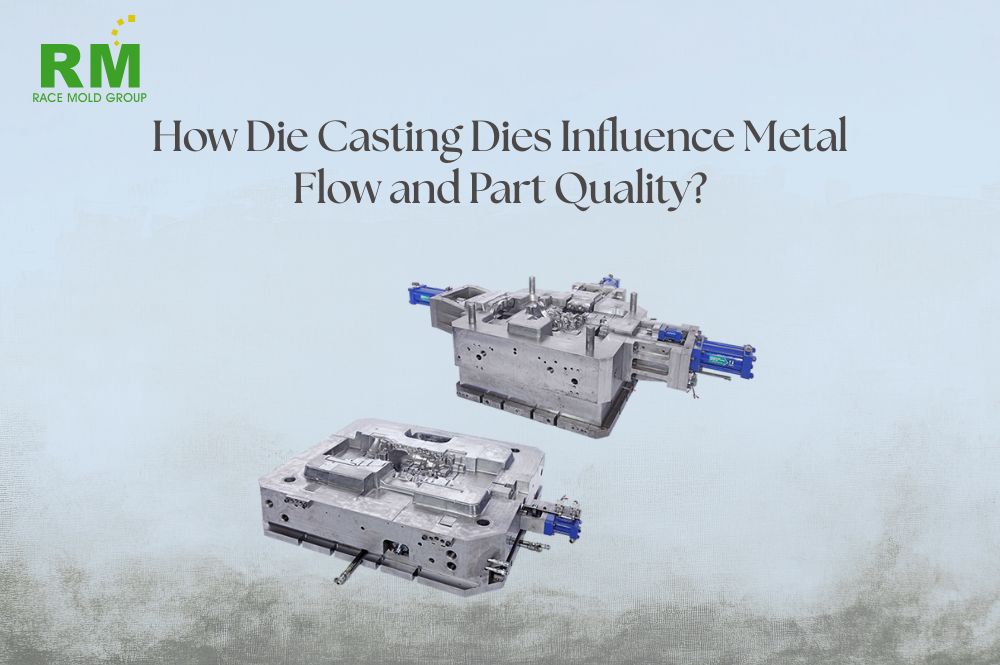
In high-pressure metal casting, few factors have a greater impact on final product quality than the design of the die casting die itself. While alloy selection and machine parameters are important, the die ultimately controls how molten metal flows, fills, cools, and solidifies inside the cavity. Poor die design can lead to porosity, cold shuts, warpage, and inconsistent mechanical strength. In contrast, a well-engineered die casting die ensures smooth metal flow, uniform solidification, and repeatable part quality.
This article explores how die casting dies influence metal flow behavior and how this directly affects part integrity, surface finish, dimensional accuracy, and structural performance.
The Relationship Between Metal Flow and Casting Quality
During high-pressure die casting, molten aluminum or magnesium enters the die cavity at extremely high speed. Within milliseconds, the cavity must be completely filled before solidification begins. The way metal flows during this short time window determines:
- Whether the cavity fills completely
- How much air is trapped inside
- Where weld lines form
- How uniformly the metal cools
- Where internal stresses develop
Die casting dies therefore act as fluid-control systems as much as they are forming tools.
1. Gating System Design: Controlling Entry and Flow Direction
The gate is the point where molten metal enters the cavity. Gate design strongly influences flow velocity, direction, turbulence level, and filling balance. If gates are too small, metal velocity becomes excessive, leading to erosion, air entrapment, and surface defects. If gates are too large, filling becomes slow, increasing cold shut risk.
Well-designed gating systems ensure:
- Balanced filling across multiple cavities
- Minimal turbulence
- Stable flow front advancement
- Consistent microstructure throughout the part
This is especially critical for thin-wall and large structural automotive castings.
2. Runner System: Delivering Uniform Metal Distribution
Before metal reaches the gate, it travels through the runner system. Poor runner layout causes uneven flow, pressure drop, and early solidification in certain areas. Optimized runner systems maintain uniform metal temperature, balance flow to multiple gates, reduce pressure loss, and prevent premature freezing. This directly improves casting density and reduces internal porosity.
3. Venting and Vacuum Systems: Eliminating Trapped Air
As molten metal fills the cavity, air must escape. Without proper venting, trapped gas forms internal porosity, surface blisters, and weak structural zones. Die casting dies incorporate micro-vents at strategic locations, vacuum-assisted extraction, and overflow wells. These features allow air evacuation while preventing metal leakage, resulting in dense, high-integrity castings.
4. Flow Path Design: Preventing Cold Shuts and Weld Lines
When two metal flow fronts meet, a weld line forms. If temperature or velocity is insufficient, weak bonding occurs — known as a cold shut. Die designers prevent this by controlling flow merging angles, adjusting gate positions, managing local wall thickness, and optimizing filling sequence through simulation. Proper flow path planning ensures strong metallurgical bonding and improved mechanical strength.
5. Thermal Management and Cooling Channel Layout
Cooling is one of the most critical die functions. Uneven cooling leads to shrinkage porosity, warpage, residual stress, and dimensional instability. Advanced die casting dies use precisely located cooling channels, zoned temperature control, and optimized thermal balance. Balanced thermal management ensures uniform solidification, consistent grain structure, and extended die life.
6. Die Surface Condition and Coatings
Surface condition inside the die influences metal flow and part finish. Rough or worn surfaces increase friction, disrupt flow, and cause soldering defects. High-quality dies feature polished cavity surfaces, anti-soldering coatings, and nitriding or PVD treatments. These improve metal release, enhance surface quality, and reduce maintenance frequency.
7. Mold Flow Simulation: Predicting Flow Before Manufacturing
Modern die casting development relies on CAE simulation tools such as ProCAST and MAGMASoft. These systems predict filling behavior, air entrapment zones, temperature distribution, and solidification sequence. By simulating metal flow before cutting steel, engineers optimize gating, venting, and cooling — dramatically reducing trial-and-error during mold trials.
Why This Matters for Automotive and EV Components
In automotive and electric vehicle production, die-cast parts must meet tight dimensional tolerances, high mechanical strength, low porosity requirements, and excellent surface quality. Common applications include motor housings, transmission cases, battery enclosures, structural supports, and cooling system components. Any instability in metal flow can compromise safety, durability, and long-term reliability.
RACE MOLD INDUSTRIAL CO., LTD. – Engineering Metal Flow for Quality Castings
RACE MOLD INDUSTRIAL CO., LTD. develops die casting dies with a strong focus on metal flow control and casting stability. Our engineering team integrates mold flow simulation, optimized gating layouts, precision venting systems, and advanced cooling designs to ensure every die delivers consistent filling behavior and reliable part integrity.
With experience in automotive, EV, industrial, and appliance castings, we build dies capable of producing thin-wall structures, complex geometries, and large structural parts while maintaining high yield rates and long die service life. From early design evaluation through final sampling, our goal is to help manufacturers achieve defect-free castings, stable mass production, and optimized manufacturing efficiency.
Conclusion
Metal flow behavior is the foundation of successful die casting. The design of die casting dies determines how molten metal enters, fills, cools, and solidifies — directly controlling porosity levels, mechanical strength, surface finish, and dimensional accuracy. By investing in well-engineered die design, manufacturers gain higher production yield, reduced scrap rates, and superior product reliability. RACE MOLD INDUSTRIAL CO., LTD. remains committed to delivering die casting dies that precisely control metal flow and consistently produce high-quality cast components for global industries.
FAQ: Die Casting Dies, Metal Flow, and Part Quality
1. Why is metal flow control so important in die casting?
Because molten metal fills the die cavity in milliseconds. Unstable flow can cause porosity, cold shuts, air entrapment, and weak bonding lines. Proper die design ensures smooth, complete filling and consistent part quality.
2. Can mold flow simulation really reduce casting defects?
Yes. CAE simulation predicts filling behavior, temperature distribution, and air traps before the die is built. This allows engineers to optimize gating, venting, and cooling layouts, significantly reducing trial runs and defect rates.
3. What die features help prevent porosity?
Effective venting systems, balanced runner design, controlled gate velocity, and optimized cooling channels all help minimize trapped gas and shrinkage porosity.
4. How does cooling channel design affect part accuracy?
Uniform cooling prevents uneven shrinkage and warpage. Well-designed cooling channels maintain stable die temperature, improving dimensional consistency and extending die life.
5. Do different alloys require different die flow designs?
Yes. Aluminum and magnesium alloys have distinct flow and solidification characteristics. Die design must account for each alloy’s thermal behavior to achieve proper filling and metallurgical bonding.
Work With a Die Casting Die Partner Who Understands Metal Flow
Precision metal casting begins with intelligent die design. Whether you are developing structural automotive parts, EV housings, or complex industrial castings, controlling metal flow is the key to stable quality and high production yield.
RACE MOLD INDUSTRIAL CO., LTD. provides engineering-driven die casting die solutions that optimize metal flow, cooling performance, and casting reliability. From mold flow analysis to final sampling, our team is ready to support your project at every stage. Contact us today to discuss your die casting die requirements and discover how we can help you achieve defect-free, high-performance castings.