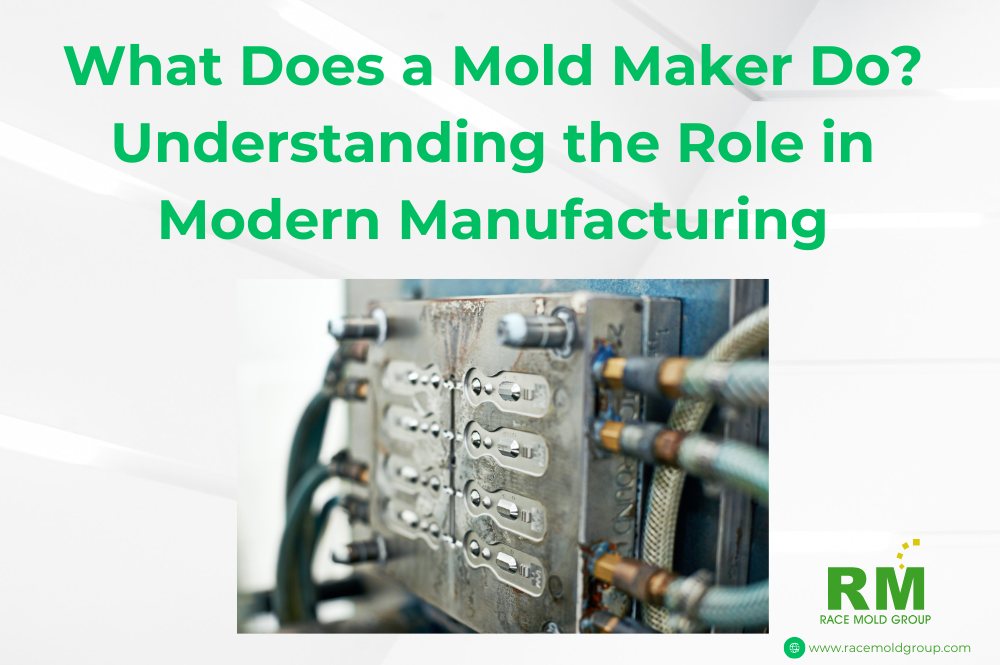
In modern manufacturing, molds are the foundation of mass production for everything from plastic components to die-cast metal parts. Behind every high-quality mold is a skilled professional known as a mold maker. These experts combine technical know-how, craftsmanship, and advanced technology to transform designs into precise tools that enable efficient, large-scale production. At RACE MOLD, we understand the importance of mold makers in every stage of production, which is why we continuously invest in precision tooling and global standards to support our customers across industries.
The Role of a Mold Maker
A mold maker is responsible for building, repairing, and maintaining molds used in manufacturing processes such as plastic injection molding, die casting, stamping, and compression molding. Their work requires interpreting detailed CAD drawings, selecting suitable materials, and machining steel or aluminum blocks into precision cavities that define the final product’s shape.
Unlike general machinists, mold makers specialize in tooling that must withstand high pressure, repeated cycles, and tight tolerances. Their role goes beyond fabrication—they collaborate with engineers and designers to ensure molds are optimized for performance, durability, and cost efficiency.
Key Responsibilities of a Mold Maker
-
Reading and interpreting blueprints
Mold makers analyze CAD drawings, 3D models, and technical specifications to understand part geometry, tolerances, and assembly features.
-
Material selection
Choosing the right mold steel or aluminum is essential. Different grades offer varying levels of hardness, wear resistance, and machinability, depending on whether the mold is for high-volume production or prototype runs.
-
Precision machining
Using CNC machines, EDM (Electrical Discharge Machining), lathes, and grinders, mold makers cut cavities, cores, and inserts with extreme precision—often within microns.
-
Assembly and fitting
Mold components such as ejector pins, cooling channels, and guide systems must be assembled and hand-fitted to ensure flawless operation.
-
Testing and troubleshooting
Mold trials are conducted to verify part quality and process reliability. Mold makers adjust tolerances, polish surfaces, or refine venting to eliminate defects like flash, warpage, or sink marks.
-
Maintenance and repair
Because molds endure thousands—or even millions—of cycles, regular maintenance is essential. Mold makers repair worn surfaces, replace damaged components, and perform preventive upkeep to extend mold life.
Skills and Expertise Required
Being a mold maker requires a unique blend of craftsmanship and technological skill. Some of the core competencies include:
-
Machining proficiency: Expertise in CNC, EDM, milling, turning, and grinding.
-
Attention to detail: Ability to achieve tight tolerances and fine surface finishes.
-
Problem-solving skills: Troubleshooting part defects and identifying mold adjustments.
-
Knowledge of materials: Understanding tool steels, coatings, and heat treatment processes.
-
Software literacy: Familiarity with CAD/CAM software for toolpath programming and design review.
This combination of skills allows mold makers to deliver tools that not only meet design specifications but also maximize efficiency in mass production.
Why Mold Makers Are Essential to Industry
Without mold makers, mass production as we know it would be impossible. Their work directly impacts:
-
Automotive: Molded parts such as bumpers, dashboards, connectors, and lighting components rely on precise molds for fit and safety.
-
Medical: Syringes, diagnostic cartridges, and surgical instruments require molds that guarantee biocompatibility and cleanliness.
-
Consumer electronics: Thin-wall housings, buttons, and optical lenses demand tight tolerances and premium cosmetic finishes.
-
Packaging: High-cavitation molds produce millions of caps, closures, and containers with repeatable accuracy.
A well-designed mold reduces production defects, shortens cycle times, and ensures consistent product quality, making the mold maker’s role indispensable in competitive industries.
The Evolution of Mold Making
While mold making was once primarily a manual craft, technology has transformed the profession. Today’s mold makers leverage:
-
CAD/CAM software for accurate 3D modeling and toolpath generation.
-
High-speed CNC machining for complex geometries and efficient toolmaking.
-
Additive manufacturing (3D printing) for prototyping and conformal cooling inserts.
-
Automation and robotics for polishing, handling, and assembly tasks.
Despite these advances, human expertise remains vital. Machines can cut steel, but only mold makers can anticipate production challenges, optimize tool design, and guarantee the reliability of the finished mold.
Conclusion
A mold maker is far more than a machinist—they are problem-solvers, precision craftsmen, and the link between product design and large-scale production. From automotive components to medical devices and consumer electronics, their work ensures that millions of parts can be manufactured quickly, reliably, and to the highest standards.
At RACE MOLD, we combine decades of expertise with advanced technology to deliver world-class molds that meet global industry demands. Whether you need precision injection molds, die casting molds, or metal stamping dies, our team is committed to supporting your success with innovative solutions and reliable craftsmanship.