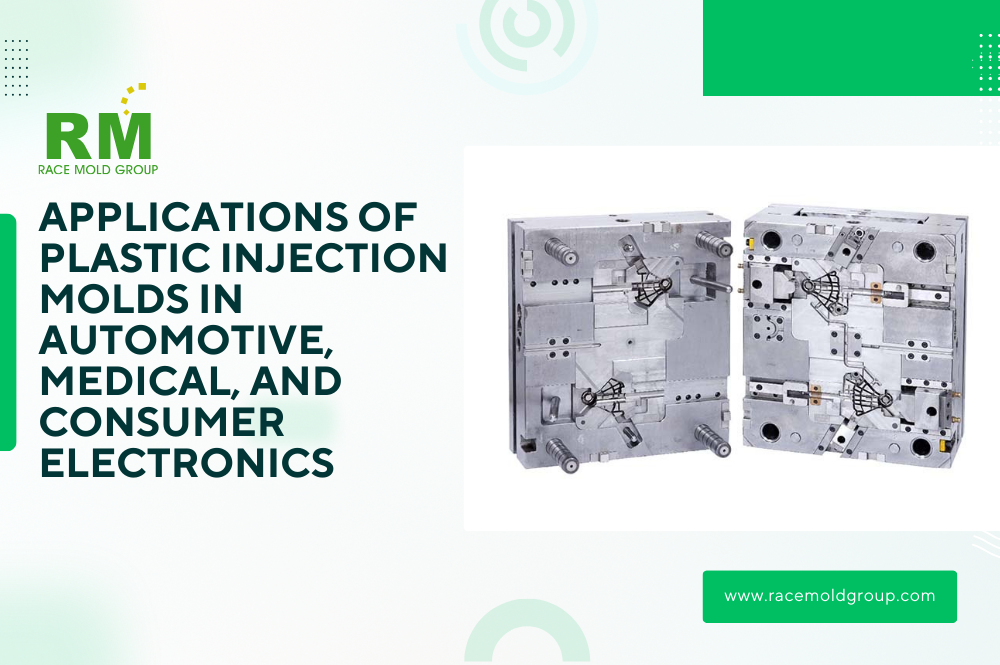
Applications of Plastic Injection Molds in Automotive, Medical, and Consumer Electronics
Plastic injection molding is the backbone of modern mass production. By forcing molten polymer into a precisely machined mold, manufacturers can deliver complex, repeatable parts at scale—often with end-use cosmetics and functional features straight out of the tool. Across automotive, medical, and consumer electronics, injection molds translate design intent into manufacturable reality, balancing cost, performance, and aesthetics. At RACE MOLD, we partner with OEMs and suppliers in these sectors to turn ideas into production-ready parts through robust mold engineering, DFM, process validation, and reliable series tooling.
Automotive: High volumes, tight tolerances, demanding environments
Typical parts. Interior trims and bezels, HVAC louvers, seat components, cable guides and clips, under-hood reservoirs, sensor housings, electrical connectors, lighting optics, and exterior grilles all rely on injection molds. Many of these parts integrate snaps, living hinges, ribs, bosses, and texture straight from the tool.
Materials and performance. Automotive polymers must handle heat, vibration, UV exposure, and chemicals. Common choices include PP and PP-T20 for trims, PC/ABS for interior structure and bezels, PA6/PA66 (often glass-filled) for under-hood components and connectors, PBT for electricals, and PMMA/PC for lamp lenses. Material shrinkage, fiber orientation, and anisotropy are controlled via mold design and processing windows.
Mold and process features.
-
Multi-cavity and family molds hit cost targets for high volumes while keeping part-to-part variation low.
-
Hot runners reduce cold sprue waste and improve filling balance across cavities; valve gates help gate blush and jetting on Class-A surfaces.
-
Gas-assist creates hollow ribbed handles, door pulls, or thick cross-sections without sink, cutting weight and cycle time.
-
Unscrewing cores form precise internal threads on fluid caps or sensor ports.
-
In-mold decoration/labeling (IMD/IML) embeds graphics beneath the surface for scratch-resistant dashboards and panels.
-
Texture and gloss management (e.g., SPI/SPE finishes) are cut into the steel to achieve consistent grain or piano-black surfaces.
Quality and compliance. APQP/PPAP, dimensional studies (CMM), and end-of-arm automation ensure stable series production. Conformal cooling and cavity pressure monitoring further stabilize cycle times and reduce warpage on large panels.
Medical: Precision, cleanliness, and validated consistency
Typical parts. Disposables (syringes, luer fittings, IV components), diagnostics cartridges and microfluidics, inhaler bodies, surgical instrument housings, and protective covers depend on highly consistent molding.
Regulatory and process controls. Cleanroom molding (often ISO Class 7/8) minimizes contamination; biocompatible materials (PP, PE, PC, COP/COC, PEEK, TPE) are selected for sterilization routes like EtO, gamma, or autoclave. Manufacturers validate tools and processes with IQ/OQ/PQ and maintain lot traceability.
Mold and design considerations.
-
High-polish steel (SPI A1/A2) for optical clarity in transparent parts and to reduce bacterial adhesion points.
-
Precision venting and balanced gating cut shear and burn marks that could compromise function.
-
Micro-molding and thin-wall design with sub-0.5 mm sections demand optimized gate types (e.g., valve or submarine) and rigid mold construction.
-
Hot runner systems tuned for medical resins shrink residence time and reduce gels.
-
Cold-well and valve timing help avoid stringing or drool that would raise particulate counts.
Risk reduction. Early mold-flow simulation predicts weld lines around luer tapers or critical seals. Steel-safe strategies allow fine-tuning of sealing diameters after first shots without remaking the tool.
Consumer Electronics: Thin walls, premium cosmetics, and fast refresh cycles
Typical parts. Phone and tablet housings, wearables enclosures, laptop bezels, battery doors, keycaps, buttons, camera brackets, speaker grills, and light pipes.
Design priorities. Tight build envelopes, ultra-thin walls (often 0.6–1.0 mm), and Class-A cosmetics are the norm. Snaps, living hinges, and bosses must survive assembly while staying hidden to preserve sleek exteriors.
Mold and process features.
-
Two-shot/overmolding bonds soft-touch TPE gaskets onto rigid PC/ABS frames, improving sealing and haptics.
-
Laser-etchable textures and film-insert molding enable icons, backlit logos, and gradient finishes.
-
Optical paths and light guides require high-polish steel, flow leaders, and gate placement away from lit zones to avoid knit lines.
-
EMI shielding can be supported via design allowances for post-mold coatings or in-mold metallization features.
-
High-cavitation tools with valve-gated hot runners keep cycle times low while meeting color and gloss specs across many cavities.
Metrology and cosmetics. Go/no-go gages, colorimetry, gloss meters, and CT scans validate fit and finish. Subtle sink over ribs is mitigated with core-outs, rib-to-wall ratios (≈0.5–0.6×), and gate cooling strategies.
Cross-industry enablers: What great molds have in common
-
Upfront simulation. Mold-flow and warpage analysis inform gate size/placement, runner balance, cooling channel layout, and venting—cutting iterations and scrap.
-
Conformal cooling. Additively manufactured inserts follow part geometry, slashing cycle times and improving flatness/yield on large panels.
-
Steel selection and coatings. H13, S136, and specialty coatings (TiN, DLC) address wear, corrosion, and release—vital for glass-filled resins and clear parts.
-
Automation and Poka-Yoke. End-of-arm tooling (EOAT) for de-gate, vision checks, and insert placement reduce labor and stabilize quality.
-
Maintenance planning. Planned PM, cavity interchangeability, and standardized components (DME/Hasco) minimize downtime and simplify global support.
Sustainability and cost: Design choices that move the needle
-
Part consolidation reduces assemblies and fasteners, improving reliability and BOM cost.
-
Material stewardship uses recycled content where appropriate, designs for regrind management, and avoids over-specifying fiber loadings.
-
Right-sizing cavitation matches demand to press time; family molds can combine related SKUs when color and cycle alignment allow.
-
Design for disassembly and standardized polymers improve end-of-life recovery.
Common pitfalls—and how mold design avoids them
-
Warp and sink. Balanced wall sections, core-outs, rib design, and uniform cooling combat distortion.
-
Short shots and burn. Proper venting, gate sizing, and processing windows alleviate trapped air and shear.
-
Knit lines in high-stress zones. Gate relocation, flow leaders, and part geometry tweaks prevent crack initiation.
-
Flash on micro-features. Tight shut-offs, precision fits, and cavity pressure monitoring keep flash at bay without over-clamping.
Bringing it together
Automotive programs push robustness and throughput, medical devices demand validated precision and cleanliness, and consumer electronics stretch cosmetics and miniaturization. In every case, success hinges on the interplay between part design, material selection, and mold engineering. The earlier mold makers are involved, the better the outcomes: fewer iterations, shorter ramps, tighter tolerances, and lower unit costs. RACE MOLD supports teams across these industries with design-for-manufacture reviews, precision tooling, and stable production ramps—so quality, speed, and margin improve together. If you’re planning your next program, talk to RACE MOLD about the right mold strategy and tooling plan for launch success.