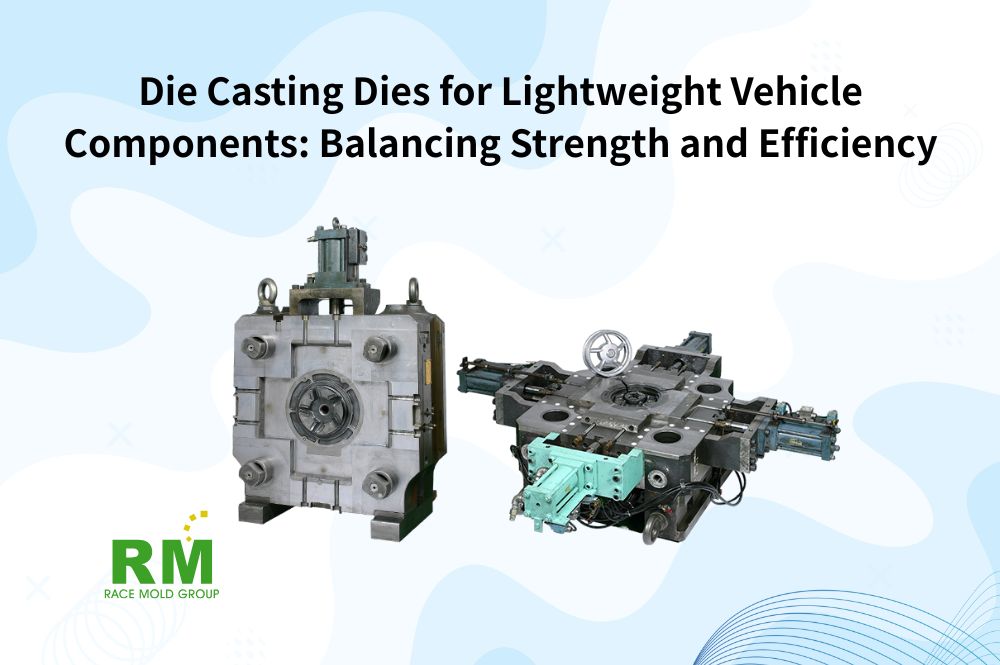
As global automotive manufacturers race toward electrification and higher fuel efficiency, lightweight metal components have become a core focus of modern vehicle engineering. From structural brackets to motor housings and battery-related parts, aluminum and magnesium die casting is now essential to reducing vehicle weight while maintaining safety and performance.
RACE MOLD INDUSTRIAL CO., LTD. leverages advanced engineering capabilities to provide die casting die solutions that meet the industry's rapid shift toward complex geometries, thin-wall structures, and stringent automotive quality requirements.
This article explores why die casting dies are crucial for lightweight vehicle components, how they are engineered, and what manufacturers should consider when selecting the right tooling partner.
Why Lightweight Components Matter in Modern Vehicles
Weight reduction is directly linked to vehicle performance. A lighter vehicle delivers:
• Better fuel economy or extended EV driving range
• Lower emissions
• Improved acceleration and handling
• Less wear on brakes, chassis, and drivetrain systems
Aluminum and magnesium are therefore widely adopted for chassis, powertrain, EV battery structures, and electronic housings. To form these precision components consistently at scale, die casting dies play a decisive role.
How Die Casting Dies Enable Lightweight Part Production
1. Thin-Wall Capability
Lightweighting depends on the ability to produce thin-wall sections without compromising strength.
Die casting dies are designed with optimized gating and venting systems to ensure:
• Smooth metal flow
• Complete cavity filling
• Minimal porosity
• Reduced risk of cold shuts
Advanced die designs can achieve walls as thin as 1–2 mm, allowing automakers to use less material while maintaining structural integrity.
2. High Dimensional Accuracy for EV and Powertrain Parts
Electric vehicles require highly precise housings for motors, inverters, and battery components.
Die casting dies support:
• Tolerances within ±0.05 mm
• Complex features like ribs, bosses, and cooling channels
• Integration of multiple components into a single casting
This reduces machining, simplifies assembly, and improves part reliability.
3. Strength Through Controlled Metal Flow
Die casting die design directly affects metal flow, which impacts mechanical strength.
Key features include:
• Strategically positioned gates
• Balanced flow distribution
• Thermal management via optimized cooling lines
These factors increase the density of the final casting and improve tensile strength—critical for safety-related parts such as brackets, control arm housings, and structural supports.
4. Compatibility with Aluminum and Magnesium Alloys
To meet lightweighting goals, automakers often choose:
• Aluminum alloys (A380, A356, ADC12, etc.)
• Magnesium alloys (AZ91D, AM60, etc.)
Die casting dies must be engineered to withstand the distinct thermal expansion, flow characteristics, and solidification rates of these materials.
Sophisticated die steel selection and heat-treating methods help extend die life while preventing heat checking and soldering.
5. Faster Cycle Times for Mass Production
Automotive manufacturing demands speed and consistency.
A well-engineered die casting die enables:
• Shorter solidification time
• Rapid ejection
• Lower scrap rates
• High repeatability in mass production
Optimized cooling channels are particularly important, as they influence cycle time more than any other factor.
Key Automotive Components Produced with Die Casting Dies
Lightweight die casting is used across multiple vehicle systems, including:
EV and Powertrain
• Motor housings
• Electric drive unit covers
• Inverter and controller housings
• Transmission casings
Chassis and Structural
• Front and rear axle components
• Cross members
• B-pillar structures
• Shock absorber mounts
Thermal and Battery Systems
• Heat sink housings
• Battery tray brackets
• Cooling plate enclosures
Interior and Exterior Modules
• Seat structures
• Steering system components
• Mirror housings
• Lighting system parts
These applications highlight the importance of durable, high-precision die casting dies in modern automotive engineering.
How to Select the Right Die Casting Die for Lightweighting Projects
When evaluating a die or a die manufacturer, consider these factors:
-
Part Geometry & Thin-Wall Requirements
Does the vendor have experience with complex, lightweight structures?
-
Mold Flow Simulation Capability
Advanced CAE analysis reduces trial-and-error and improves casting quality.
-
Steel Material & Heat Treatment
High-grade die steels such as H13, W302 ESR, or DAC55 are essential for durability.
-
Cooling System Design
Efficient cooling reduces cycle time and boosts die life.
-
Die Size & Machine Compatibility
Consider press tonnage, die dimensions, and projected parting surface area.
RACE MOLD: Your Partner for High-Performance Die Casting Dies
At RACE MOLD, we support automotive and EV manufacturers with complete die casting die solutions, including:
• Aluminum and magnesium die casting dies
• Support for large-scale tools up to 25 tons
• Capability for die casting machines up to 2,700 tons
• Engineering services including DFM, mold flow analysis, and optimization
• Experience across automotive, industrial, appliance, medical, and electronic sectors
Our goal is to help customers achieve lightweight designs without compromising strength, safety, or manufacturability. From early-stage concept review to final sampling, we work collaboratively to ensure your die casting dies deliver efficiency, precision, and long-term reliability.
Conclusion
Lightweight vehicle components are redefining the future of mobility, and die casting dies are at the core of this transformation. Their ability to support thin-wall structures, complex geometries, and high-precision requirements makes them indispensable to automotive and EV manufacturing.
At RACE MOLD INDUSTRIAL CO., LTD., we are committed to supporting your lightweighting goals with engineering-driven die casting die solutions.
If your team is exploring die casting dies for lightweight vehicle applications, contact us to discuss your project—we’re ready to support you from design to production.
FAQ: Die Casting Dies for Lightweight Vehicle Components
1. What materials are commonly used for die casting dies?
High-performance tool steels such as H13, Bohler W302 ESR, and DAC55 are widely used due to their thermal fatigue resistance and durability under high-pressure casting.
2. How long does a die casting die typically last?
Depending on alloy type, part complexity, and cooling design, a high-quality die can last anywhere from 50,000 to over 200,000 shots. Proper maintenance significantly extends die life.
3. Why are die casting dies essential for thin-wall automotive components?
Die designs determine metal flow, venting, and cooling efficiency—all critical to preventing porosity and ensuring structural integrity in thin-wall castings.
4. What is the main challenge in die casting EV components?
Most EV components require tight tolerances and complex geometries, meaning the die must maintain dimensional accuracy while resisting extreme thermal cycling.
5. Can die casting dies reduce machining requirements?
Yes. With precise cavity design and optimized gating, many features—such as ribs, fastening points, and cooling channels—can be cast directly into the part, reducing post-machining costs.